
Python Homework Help -Your Topic, Your Expert, 30 Minutes
Upload your Python assignment with the rubric, deadline, Python version, and allowed libraries. A project manager reviews it within 30 minutes and matches you with the Python expert best suited to your topic.
You can talk to the expert before approving the price or making any payment.
Students Helped Worldwide
Coding Assignments Completed
From 900+ Student Reviews
Programming Languages
Here Is What Makes Our Python Homework Help Different
Python skips the boilerplate that slows down Java and C++. Professors pack more complexity into fewer weeks so your syllabus jumps from print("Hello World") to pandas DataFrames to full Django web applications in a single semester. The assignments scale to match, but the lectures don’t.
When you request Python homework help, a project manager reads your rubric within 30 minutes and matches you with a Python programmer who already works with the specific library or framework your assignment targets. One expert handles your project from upload to final revision, reads the rubric, writes the code, and explains the reasoning.
Why So Many Students Need Help With Python Assignments
Your code runs fine on your laptop. It fails on the autograder. Your professor covered pandas for one lecture, and your assignment has 50,000 rows, missing values, and edge cases that never came up in class. And sometimes a single invisible space is all it takes to break 100 lines of working code with an error that points nowhere.
These are not skill problems. They are time and context problems, and our python expert can help you to fix them fast.
Python shows up in courses that were never meant to be programming courses
Economics students, social science students, biology students and business analytics students are all assigned Python today. These students never chose to become programmers. When data analysis or machine learning appears on a syllabus, many of them have no background to draw on. The assignment arrives, the deadline is real, and the gap between what is expected and what was taught is genuinely wide.
University Python courses move fast and do not slow down for the parts where students get stuck
A well-resourced university might have tasks reviewed by multiple instructors before they go out. Most do not. Students hit ambiguous requirements, vague error messages and graders that behave differently from their local setup, with no clear path to fix any of it before the deadline.
The word Python covers an enormous range of difficulty
A student typing Python homework help into a search bar might need help with a 10-line beginner script or a full machine learning pipeline for a final year data science project. The range is enormous. Most platforms treat it as one thing. On MyCodingPal the expert matched to your assignment actually knows the difference and builds to your course level, not a general standard.
Your Matched Python Expert Talks to You Before Any Payment
Most Python homework help platforms ask you to pay first and explain who is working on your assignment later. By the time you find out the expert is not the right fit, you have already paid.
MyCodingPal works differently. When you send us your Python assignment, a project manager reviews your rubric, deadline, Python version, allowed libraries, and topic within 30 minutes. Then we match your work with the Python expert best suited to that assignment.
Before you make any payment, you can discuss the requirements with the matched expert. You can ask how they understand the task, what approach they plan to use, and whether the solution will follow your course rules. If the plan, expert, or price does not feel right, you can walk away without paying anything.

How It Works
Send us your assignment and a Python expert will read it and get in touch within 2 hours. The consultation is free. Nothing is paid until you agree on the plan.
Step 1: Send Us Your Assignment
Upload your file, whether that is a .py script, a Jupyter Notebook, a PDF brief or just a written description. Tell us your deadline, which Python version you use and which IDE. Add any library restrictions or special instructions.
Step 2: Get Matched with the Right Python Expert
We review your assignment and connect you with the programmer who is the best fit for your specific task. You can see their profile and work history before anything starts.
Step 3: Talk to Your Expert and Agree on a Price
Your expert reads your brief, asks any important questions and confirms the plan in writing. You get a fixed price after this conversation. Nothing is charged before you approve the plan.
Step 4: Pay 50% and Track Progress
Pay half to get started. You can ask your expert questions at any point during the work. For bigger projects, payments are released as each stage is completed.
Step 5: Review the Work and Finish
Check the code, the explanation document and the run guide. Pay the remaining 50% when you are happy. Ask for revisions within 72 hours if something needs to change. Book a walkthrough session whenever you are ready.
What You Get With Every Python Order
Every Python assignment delivered through MyCodingPal comes with the same complete package. Nothing is an add-on. Nothing costs extra.
We Check Which Python Version Your University Uses
Your laptop might have a newer version of Python than what your university uses for grading. This is a very common reason why code fails on submission even when it runs fine at home. We always check the right version before we start and build the solution to match it exactly.
Comments That Help You Explain Your Code
Every solution comes with comments that explain the reasoning behind the code. Not just what it does but why it was written that way. When your professor asks questions in class or a code review, you know what to say.
A Written Explanation With Every Order
Every solution comes with a document that explains the main decisions in plain English. Why was this approach chosen. What each function does and why. Read it once and you are prepared for the questions your professor is likely to ask.
A Setup File So the Code Runs First Time
We include a requirements.txt file with every order. It lists the exact libraries your solution needs. One quick command installs everything and the code runs the same way on any computer. This prevents the most common last-minute problem: code that works on our side but throws an error on yours.
We Write Every Line From Scratch, No AI Shortcuts
Our experts write your Python solution by hand based on your specific assignment. We do not use AI to generate the code and we do not recycle old solutions. If your assignment allows AI tools, we use them with your permission and we mark every AI-assisted part clearly so you can explain it to your professor.
Every Python Topic We Help With
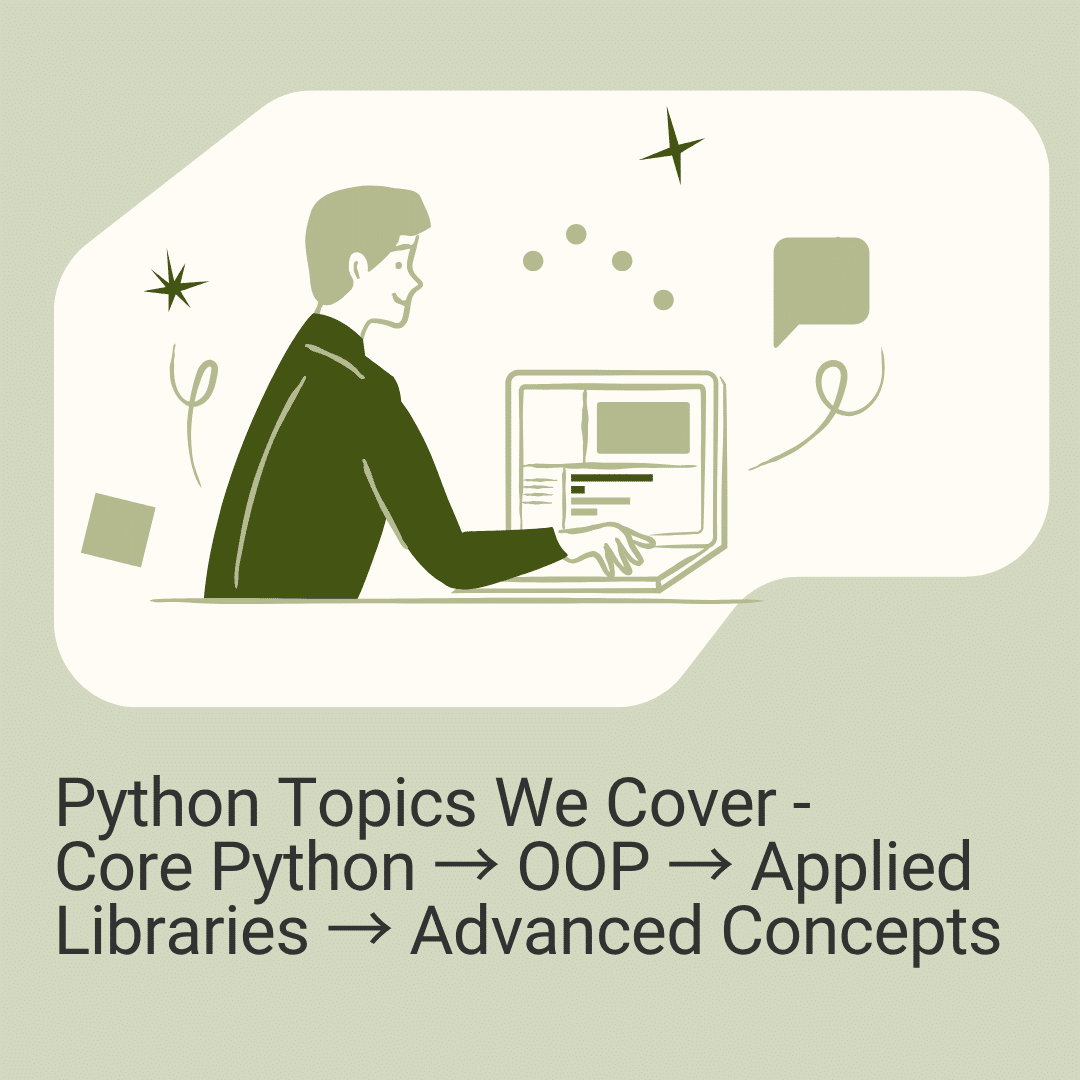
We help with Python programming homework across every topic your course covers. Most Python courses follow the same progression: core syntax first, then object-oriented programming, then real-world libraries and frameworks. Each stage brings a different type of problem, and our experts know exactly what students get stuck on at each one. The topics below are organized the same way your course teaches them.
Core Python - Where Invisible Bugs Start
Your laptop might have a newer version of Python than what your university uses for grading. This is a very common reason why code fails on submission even when it runs fine at home. We always check the right version before we start and build the solution to match it exactly.
OOP and Intermediate Concepts - Where Python Stops Feeling Easy
If your assignment uses a Jupyter Notebook, we send it back with every cell executed and the output showing. Your grader needs to see the results. A notebook with empty cells looks like you never tested the code.
Applied Python - Libraries, Frameworks, and the Real Assignments
There is no point getting code that uses tools or libraries your professor has not taught yet. It looks suspicious and you cannot explain it if asked. We read your brief carefully and write the solution at the right level for your course.
Advanced Semester: Machine Learning, Async, and the Deep End
Pandas, NumPy, Matplotlib, Scikit-learn, TensorFlow, Keras, PyTorch, Flask, Django, Selenium, NLTK, spaCy and more. Whatever your assignment calls for, we have a specialist who knows it well.
We also help with AI agent assignments, including LangChain agents, RAG chatbots, tool-calling workflows, vector database search, OpenAI API projects, and Streamlit or FastAPI demos.
How Much Does Python Homework Help Cost?
| Assignment Type | Complexity | Turnaround | Real Example |
|---|---|---|---|
| Scripts and Command-Line Tools | Introductory | 12–24 hours | Number guessing game, text file word counter, basic calculator with error handling |
| OOP Class Hierarchies | Intermediate | 24–48 hours | Bank account system with inheritance, student record manager, library catalog |
| Data Analysis with pandas | Intermediate | 24–48 hours | EDA on Kaggle dataset, pivot tables with visualizations, time series analysis |
| Machine Learning Pipelines | Intermediate–Advanced | 48–72 hours | Sentiment classifier, housing price predictor, customer churn model with Jupyter report |
| Web Applications (Django/Flask) | Advanced | 3–5 days | Blog with authentication, REST API for a task manager, e-commerce product catalog |
| GUI Applications (Tkinter/PyQt) | Intermediate | 48–72 hours | Quiz app, inventory tracker, grade calculator with charts |
| Web Scraping and Automation | Intermediate | 24–48 hours | E-commerce price monitor, job listing scraper, automated PDF report generator |
| Database-Backed Applications | Intermediate–Advanced | 48–72 hours | CRUD app with SQLite or PostgreSQL, SQLAlchemy models with migrations |
| Algorithm Implementations | Intermediate–Advanced | 24–48 hours | Custom graph traversal, sorting algorithm benchmarking, dynamic programming solutions |
| API Development | Advanced | 3–5 days | FastAPI microservice, Flask REST API with JWT authentication, webhook integration |
Will My University's Plagiarism Checker Flag This?
The Invisible Whitespace Bug
Python treats indentation as syntax. One tab mixed with spaces often invisible in most editors triggers an IndentationError that points to a line looking perfectly fine. Students who copy code from Stack Overflow answers, PDF slides, or Slack messages inherit formatting conflicts they cannot see. Our experts toggle whitespace visibility in the first 30 seconds and resolve what takes students hours of frustrated staring.
The Autograder Surprise
A student runs their script 15 times locally. Every output matches. They submit to Gradescope, and 4 test cases fail. The grading system sends inputs the student never considered: empty strings, negative numbers, None values, Unicode characters, and lists with duplicate elements. Python's dynamic typing lets the code run without catching these mismatches until the wrong input hits the wrong function at runtime. Our experts write defensive code that handles the edge cases professors design to separate strong submissions from weak ones.
The pandas Pipeline That Produces Wrong Numbers Without Crashing
This is Python's most dangerous category of bug: code that runs, produces output, and the output is wrong. Applying .groupby() before cleaning NaN values drops rows silently. Chaining .fillna() without assigning the result means the cleaning never actually happened. Using .loc[] on a DataFrame copy instead of the original triggers SettingWithCopyWarning or worse, corrupts the data without any warning at all. Our experts validate each transformation step from raw CSV to final output.
The Recursive Function That Hits Python's Ceiling
Python's default recursion limit sits at 1,000 stack frames. A student writes a recursive solution that passes small test cases but crashes with RecursionError when the autograder feeds it an input of 5,000 elements. The algorithm is correct in theory; it just needs memoization with functools.lru_cache or conversion to an iterative approach. Our experts know which optimization fits the assignment's requirements and constraints.
The "Due Tomorrow, Haven't Started" Emergency
The assignment is worth 15% of your grade. It's due in 16 hours. Life happened: work, midterms in other classes, and a family obligation. When students search for "do my Python homework" at midnight, this is usually the reason. It's not about laziness; it's about triage. Our rush delivery handles urgent Python assignments. Simple scripts ship within 6–12 hours. Complex projects follow a realistic timeline, and work begins immediately after you approve the expert and quote.
MyCodingPal vs. AI vs. Other Services - An Honest Comparison
ChatGPT and AI Code Generators
- Generic code that ignores your rubric
- Fails hidden test cases and autograder
- No personalized explanations
- No revisions or ongoing support
- Flagged by AI detectors
- Ignores PEP 8 and professor's standards
- 50 students get same output
MyCodingPal
- Rubric-matched custom code
- Tested against edge cases
- Talk to expert before paying
- 100% unique, human-written
- Unlimited revisions
- 50/50 payment protection
- Full Refund Guarantee
- Solution with full explanations.
- Educational-Based Approach
- Co-Solving Sessions
- Debugging and Code Review
Other Services and Essay Mills
- Anonymous coders
- Inconsistent quality
- No expert access before pay
- No Refund Guarantee
- May use AI tools
- Limited revisions
- Full Payment Upfront
8 Guarantees You Get Before, During, and After Your Python Homework
These 8 guarantees define every Python homework help order on MyCodingPal. Each one answers a real concern students have before they share files, approve the expert, or make the first payment.
1. Talk to Your Python Expert Before Work Begins
Your Python expert reviews the rubric, deadline, Python version, allowed libraries, starter files, and submission format before payment. You can ask questions, explain course rules, and approve the plan only after the scope and price are clear.
2. Verified Python Programmers With Topic Experience
Your assignment is matched with a Python expert who fits the actual task. pandas, Django, recursion, web scraping, and machine learning require different experience, so the match is based on your brief, not a generic programming profile.
3. Explained Python Solutions With Useful Comments
Every solution includes comments where they help. Your expert explains the logic, functions, inputs, outputs, and key decisions in plain English so you understand how the code works.
4. 50/50 Payment That Protects Your Order
You pay 50% after approving the expert, scope, and price. The remaining 50% is paid after you review the completed work. Larger Python projects can be split into milestones when the task has separate stages.
5. Revisions Until the Approved Brief Is Met
The same expert reviews any issue tied to the approved instructions. Missing requirement, broken output, setup issue, or unclear explanation gets fixed under the revision process when it belongs to the original brief.
6. Python Code Quality Checked Before Delivery
Your solution is checked for syntax errors, indentation, imports, output format, and common edge cases. For autograded assignments, the expert also checks function names, return values, input handling, and extra print statements.
7. Ready-to-Run Files With Setup Support
You receive the format your course asks for, such as .py, .ipynb, .zip, a PDF report, or a project folder. When libraries are involved, your delivery includes setup notes or a requirements.txt file so the code runs on your side.
8. Private Communication and Full Confidentiality
Your files, messages, assignment brief, and delivered solution stay private inside MyCodingPal. We do not publish your code, reuse it for another student, or show your order as a public sample.
Meet the Python Experts on MyCodingPal
MyCodingPal has 20+ verified programming experts. These 4 Python specialists handle the most common Python assignment types students bring to us, including data science, web apps, algorithms, and automation.

Anthony M. - Python Specialist
Expertise: Python programming, data science, machine learning, and Jupyter Notebook assignments.
Experience: 10+ years of professional Python experience. With us since 2018 and has helped 500+ students with data science.
Skills: Building pandas pipelines, training scikit-learn models, creating matplotlib visualizations, and writing clear study-style explanations.

Harrison L. Python Web Development Specialist
Expertise: Python web development using Django, Flask, and FastAPI.
Experience: 8+ years building production Python web applications and has completed 300+ student web projects.
Skills: Developing route-and-template projects, full-stack apps with SQLAlchemy, user authentication, Docker deployment, and clear README documentation.

Marcus T. Python Algorithms Specialist
Expertise: Algorithms, data structures, and coding interview problem-solving.
Experience: Has mentored 200+ students through core computer science assignments and interview-style practice.
Skills: Linked lists, binary trees, graph traversal algorithms, sorting benchmarks, Big O analysis, and explaining algorithm selection clearly.

Elena R. Python Automation Specialist
Expertise: Python automation, web scraping, and ETL workflows.
Experience: 6+ years of Python automation experience handling structured data extraction and workflow development.
Skills: Beautiful Soup scraping, Selenium browser automation, Scrapy pipelines, file processing with os and pathlib, pagination handling, rate limiting, and error recovery.
Python Homework Help Pricing: 3 Options Starting at $20
Debugging and Code Review
Get help with debugging and code review for your projects.
Starting at $20
Your Python code mostly works, but something isn’t right. Maybe an IndentationError that resists fixing. Maybe a pandas operation returning unexpected NaN values. Maybe your recursive function hits the limit on larger inputs. Expert analyzes the code, identifies issues, fixes it, and explains what went wrong so you recognize the pattern next time.
Complete Python Assignment
Complete Python assignment written from scratch with full explanation document and code comments.
Starting at $30
A Python programmer writes your assignment from scratch, from reading the rubric to delivering commented, tested, documented code with an explanation file. This is the most requested option for students who say do my python assignment and want full understanding of what gets submitted. PEP 8 compliant plagiarism-free original work.
1:1 Walkthrough Session
Book a live session with the expert who wrote your code. They walk through it, answer your questions, and help you explain it confidently.
Starting at $40
Work through your assignment side-by-side with an expert via screen sharing. Your tutor doesn’t solve the problem for you they guide you through solving it yourself, explain concepts as you code, and build skills that carry into future assignments. Students who want help with Python homework while actually learning the material choose this option.
Python Homework Helper for Every Course Level, From First Loop to Final Capstone
Students come to MyCodingPal with very different Python assignments. Some are working through their first for loop, list problem, function, or file-handling task. Others are stuck on pandas DataFrames, Jupyter notebooks, API projects, Django apps, recursion, web scraping, or machine learning models.
That range matters. A beginner solution should match beginner coursework. An advanced project needs an expert who understands libraries, datasets, edge cases, and grading rules. MyCodingPal works as a Python homework helper by matching your assignment with the right expert for the topic, course level, allowed libraries, and submission format.
The result is code that fits your class. Not overbuilt. Not too basic. Just the right level for the assignment you actually have.
What Students Say About Our Python Homework Help
These are real students who came to MyCodingPal with Python assignments. Here is what they said after delivery.
Students from 45+ Countries Submit Python Assignments Through MyCodingPal
Gradescope at UC Berkeley runs Python 3.10 with a restricted library list. CodeGrade at the University of Amsterdam enforces PEP 8 compliance as part of the grade. Vocareum at Georgia Tech resets sys.path between test cases. Each autograder has quirks that break code written for a different platform, and our experts know them because they’ve submitted to all of them.
- 24/7 availability means your Python expert responds within 30 minutes regardless of time zone. Students from the United States, United Kingdom, Canada, Australia, Germany, Singapore, and 40+ other countries work with MyCodingPal — often across semesters.
- A student who requests help debugging IndentationError in CS101 comes back for a Django capstone project two years later. The same expert can track your progression and adjust explanations as your Python skills develop from for loops to TensorFlow pipelines.
Questions Students Ask Before Ordering
How do I verify my Python expert's qualifications before paying?
A project manager matches your assignment with a Python expert based on the topic, course level, deadline, and required tools. You can ask about the expert’s relevant experience before approving the price. A pandas task, Django project, recursion problem, and machine learning notebook are not sent to the same kind of expert.
Can I talk to my Python expert before I pay?
Yes. You can talk to the matched expert before placing the order. The expert reviews your brief, asks questions about the rubric, confirms the approach, and explains what can be done before you make the first payment.
What Python topics, libraries, and frameworks do your experts support?
We support core Python, OOP, data structures, pandas, NumPy, Matplotlib, scikit-learn, TensorFlow, PyTorch, Flask, Django, FastAPI, Selenium, Beautiful Soup, Scrapy, NLTK, spaCy, SQLite, PostgreSQL, and Jupyter notebooks.
Can your Python experts handle data science and machine learning assignments?
Yes. Our Python experts handle CSV cleaning, pandas DataFrames, NumPy arrays, Jupyter notebooks, data visualization, scikit-learn models, TensorFlow or PyTorch projects, model evaluation, and written analysis for data science coursework.
How much does Python homework help cost at MyCodingPal?
Python debugging starts at $20, complete Python assignments start at $30, and 1:1 walkthrough sessions start at $40. The final quote depends on the deadline, topic, files, rubric, and complexity. You see the fixed price before payment.
How does the 50/50 payment work?
You pay 50% after approving the expert, scope, and price. The remaining 50% is paid after you review the completed work. For larger Python projects, we can split the order into milestones so each stage is reviewed separately.
What if something is wrong after delivery?
Ask for a revision if the delivered work does not match the approved brief. The same expert reviews the issue first. If needed, a second expert checks it. If the final work still does not match the agreed requirements, the refund policy applies.
Do you handle urgent Python assignments due within 24 hours?
Yes, when the scope is realistic. Small debugging tasks, short scripts, and basic notebooks can often be handled within 24 hours. Larger Django, data science, or machine learning projects need more time, so the expert confirms the deadline before payment.
Will I be able to explain my Python code to my professor?
Yes. Every completed order includes comments and a plain-English explanation of the main logic. You can also book a 1:1 walkthrough with the expert who worked on your assignment if you want live explanation after delivery.
Is my Python homework submission plagiarism-free and confidential?
Yes. Your solution is written for your assignment brief and is not reused for another student. Your files, messages, personal details, and delivered code stay private inside MyCodingPal.
Ready to Get Your Python Assignment Done?
Send us your Python assignment with the rubric, deadline, Python version, and allowed libraries. A project manager reviews it within 30 minutes and matches it with the right Python expert. You can speak with the expert before approving the price or making any payment.
- Talk to your Python expert before you pay anything
- Solutions matched to the methods your course has covered
- Working code, explanation document and run guide included on every order
- Real completed samples to browse before you decide
- Book a 1:1 walkthrough with your expert after delivery